The best places to bring your dog in Texas are the ones with a clear rule, some shade, and a plan for when your dog is done. Famous views are optional. A six-foot leash and a water bowl are not.
Start with the rule, then the place
Texas does not have one statewide beach or trail policy for dogs. State parks do share a baseline, and it is worth memorizing because it covers so many weekends. Texas Parks and Wildlife requires pets to be on a leash no longer than six feet, or in a vehicle or crate. You stay with them. They do not go into park buildings, and they do not go into the water or onto the land beside a designated swim area. You need proof of a current rabies vaccination, and you pick up waste. Break the rules and staff can ask you to leave.
That baseline is not the whole story. The same agency lists parks with extra limits, including Enchanted Rock and Big Bend Ranch. National parks and city beaches publish their own pages. A map pin that says “dog friendly” is a starting point. The park, forest, or city page is the one that decides whether your dog can leave the parking lot. When a rule below is general, that is on purpose. Policies change, and a posted sign beats a travel article.
Heat is the other rule, and it is not printed on a gate. Texas pavement, sand, and rock can burn paws well before the air feels extreme to you. Carry drinking water. Offer shade before your dog looks desperate. Cut the outing short if panting does not settle during a rest. A shorter morning loop is a better memory than a long afternoon your dog spends trying to recover.
East Texas and the Piney Woods
For a Houston dog, the Piney Woods are the realistic overnight. The drive is measured in a couple of hours, not a full day, and the landscape changes to pines and lake water instead of another freeway. Huntsville State Park and Lake Livingston State Park are the public parks people mean when they talk about dog days in that lake country. Treat them as Texas state parks first: six-foot leash, no unattended dogs, no pets in buildings or designated swim areas, rabies paperwork in the car. Trail maps and any local closures belong on the park’s own page the week you go.
Sam Houston National Forest is the larger green space next door to that lake country. National forest land is not a state park, and the leash customs in a developed campground are not the same thing as an open woods road. Do not assume an off-leash hike is allowed because the trees look empty. Check the forest’s current guidance, keep the dog close around other visitors, and skip anything that looks like a wildlife closure.
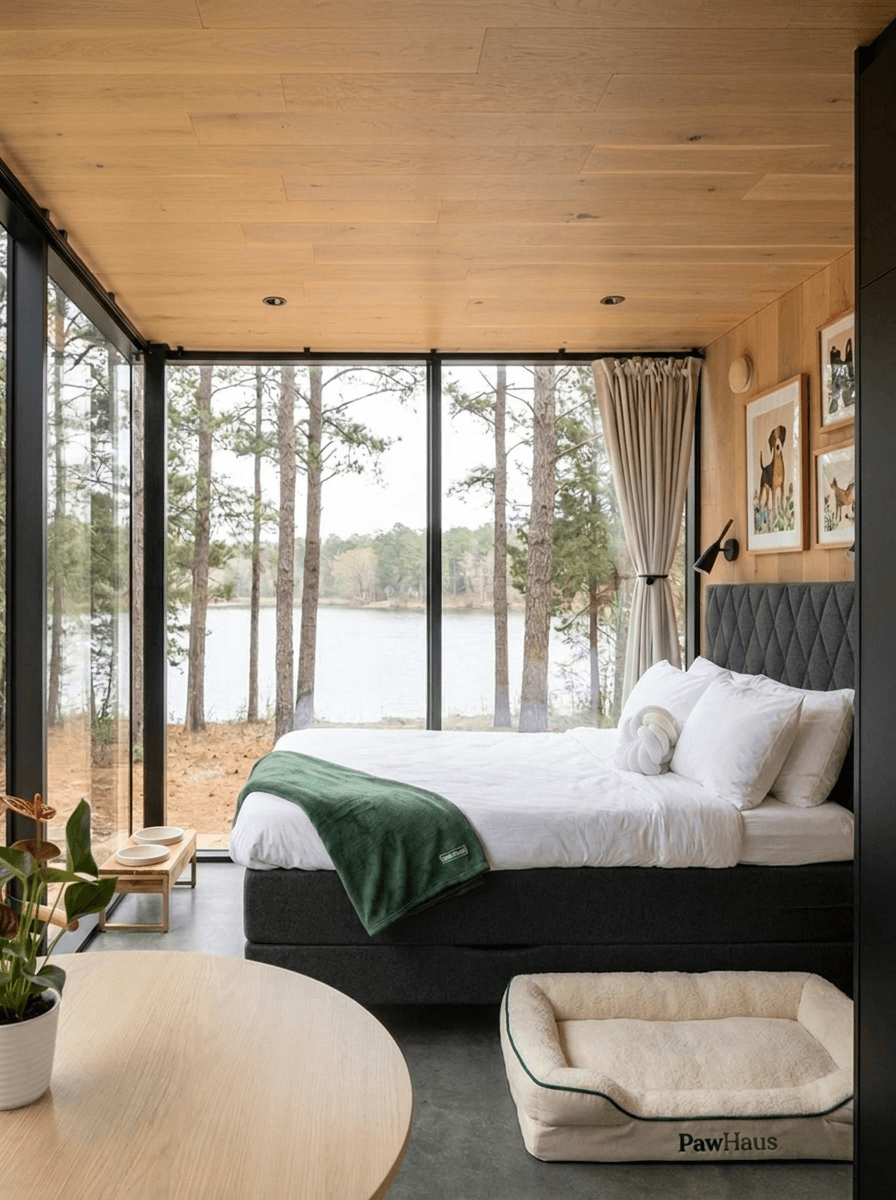
PawHaus Resort is the home base we built for this part of the state. It opens January 1, 2027, in Goodrich, Texas 77335, on 30 acres along Sleepy Hollow Lake, about 90 minutes from Houston. The twelve ÖÖD mirror houses each have a small private yard and a dog rinse. Off-leash time on the property is the fenced dog park or that private yard. The rest of the resort is on leash. Sleepy Hollow Lake does not allow motorized boats. Kayaks are at the guest’s own risk, which is a different outing from a swim beach at a state park. Use the houses to recover between lake walks, and use the Lake Livingston page and local experiences when you want the public side of the same weekend. The lake activities guide is the slower version of a day on the water.
Hill Country towns and short trails
Fredericksburg is the Hill Country town most people picture: a walkable main street, day trips in every direction, and a lot of patios. Dogs are a normal sight on the sidewalk. They are not automatically welcome in a tasting room, a shop, or a restaurant patio. Ask. The same is true in Gruene and New Braunfels, where the river is the attraction and many tubing and swim spots are organized around people, not pets. A river afternoon can still work if you treat it as a leashed bank walk and a nap, not as an assumption that every outfitter will load your dog into a tube.
Enchanted Rock is the hike everyone wants to add. It is also on the state-park list of places with extra pet restrictions, which exist to protect the park and the dog. Do not drive there on the strength of the general six-foot-leash rule. Read the park’s current pet notes. If the summit or the backcountry is off limits to your dog that day, pick a different trail instead of discovering it at the trailhead with a tired dog in the car.
A Hill Country weekend is easier when the lodging has a yard or a clear walk, because the days fill up with short stops. If you are coming from Houston and would rather not add another three hours of driving, the Piney Woods version of the same idea is PawHaus plus a state park morning. The houses and the dog park and indoor play area cover the hours when a town sidewalk is enough walking and the dog still needs to run.
Austin and Dallas, on leash unless posted
Austin’s dog reputation is real, and it is also specific. City rules require a leash in public except in a designated off-leash area. You leash the dog on the walk to that area, and inside it the dog stays in sight and under voice control. Red Bud Isle, on Lady Bird Lake below the Tom Miller Dam, is the off-leash spot locals mean. It is popular, which means other dogs, water access, and a reason to leave if your dog is overwhelmed. Zilker and the Lady Bird Lake trail are not a blanket off-leash zone. Use a posted off-leash area when you want one, and a leash on the rest of the path.
Lady Bird Lake has a second caution that matters more than the view. The city has warned that harmful algae there can sicken or kill dogs, and it is more likely in summer and fall. If you cannot see a current advisory, do not let the dog drink the lake water or swim because other dogs are doing it. Carry your own water. A pretty shoreline is not a bowl.
In Dallas, White Rock Lake is the equivalent walk: a long shoreline loop and a fenced off-leash dog park on the northwest side of the lake. Use the dog park for the off-leash part and a leash on the path. The city’s dog-park page notes closures for rain and for a weekly maintenance day, so a quick check saves a wasted drive. North Texas heat applies the same paw rule as the rest of the state. Go early, and do not plan the whole loop if your dog is already done at the halfway water stop.
Gulf beaches, with the leash still on
Padre Island National Seashore is the long beach people drive for. The National Park Service allows leashed pets on park beaches, campgrounds, trails, and boardwalks, with a leash up to six feet. Pets stay out of buildings. The park also asks visitors not to bring disruptive or aggressive pets onto the Malaquite Visitor Center deck and boardwalk, or onto the short beach directly in front of the visitor center. Waste gets picked up. Dogs should not chase birds. Summer heat on open sand is serious. Bring water, a shade plan, and a reason to leave before the dog is cooked.
Port Aransas is the nearer island town, and its visitor bureau describes the beaches as open to dogs on a leash no longer than six feet, with cleanup required and no off-leash beach. That is a published city welcome, not a rumor, and it is still worth confirming before a holiday weekend because local enforcement and nesting closures can tighten a rule without rewriting a travel blog. Galveston’s Park Board publishes a simpler line: leashed pets are permitted on its beaches, and people should clean up after them. Do not read that as permission for every jetty, nesting area, or private stretch. Stay off the dunes, skip glass, and re-read the Park Board’s beach rules if you are aiming at a specific park such as East Beach or Stewart Beach.
A beach day is a better add-on than a surprise. If your dog has never seen surf, the first visit should be short and on a leash, with an exit that does not depend on the dog suddenly loving waves. Rinse sand and salt off paws afterward. None of these beaches replace a yard at the end of the day. If the coast is the whole trip, book lodging that states its pet rules in the same detail as the beach.
Big Bend, where the car sets the boundary
Big Bend National Park is extraordinary and a poor place to improvise with a dog. Park rules are plain: pets are not allowed on trails, off roads, or on the river. They can go where your car can go. The leash maximum is six feet. You may not leave a dog unattended in a vehicle if that puts the animal in danger or creates a nuisance, which in desert heat is most of the day. There is no kennel inside the park. A trail day means another person stays with the dog, or you arrange boarding outside the park before you go. The Boquillas crossing into Mexico is not a pet crossing either.
Big Bend Ranch State Park, next door, is not a loophole. Its dog policy is tighter than the usual Texas state park. Dogs stay within a quarter mile of campsites or designated roads, and the park limits trail use to Closed Canyon and the Hoodoos Trail along FM 170. Other hiking trails and the backcountry are not dog hikes. The desert heat and rock are part of the reason. If those limits do not fit the trip you wanted, leave the dog at a sitter and hike, or choose a park that actually wants dogs on the trail.
Both pages are maintained by the agencies that enforce them, and both have been stable for a long time. Still check them before a long drive. A rule change is cheaper to read at home than to discover in Study Butte.
Use a home base instead of changing hotels every night
The places above are day trips and park visits. The stay wrapped around them decides whether the dog sleeps well. A new hotel every night means a new floor, a new elevator, and a new set of pet rules. For East Texas, one base is simpler. PawHaus is that base for the Piney Woods: Goodrich, Sleepy Hollow Lake, and houses that already assume a dog is coming. There is no dog fee, no breed restriction, and no size limit. Petite and Standard houses sleep two people and up to two dogs. The Monolith sleeps up to four people and three dogs and has a private hot tub. Details live on the stay page.
Pack for the park, not for a photoshoot. Food your dog already eats, a leash, water, waste bags, rabies and DHPP records, and a crate if the dog will be alone in the house. Bordetella is required at PawHaus only for the dog park, grooming salon, or indoor play area. The policies page and the FAQ are the short versions. The packing guide is the longer one.
If the weekend starts in Houston, the getaway guide is about the drive itself. If you are still comparing what “dog friendly” should mean in a hotel, the Texas hotels guide walks through fees, limits, and yards. The places in this article are worth the trip when the rule is clear and the dog still has somewhere calm to sleep. That is the whole standard.
Questions to settle first
Are dogs allowed in Texas state parks?
Yes, in most state parks, on a leash no longer than six feet. Pets must stay with you, stay out of buildings and designated swim areas, and have proof of a current rabies vaccination. Some parks add extra limits, so check that park’s page.
Can I hike with my dog in Big Bend National Park?
No. Pets are not allowed on trails, off roads, or on the river. They may go only where a car can go, on a leash no longer than six feet. There is no kennel in the park.
Which beach rules are the safest to rely on?
Read the agency that manages that beach. Padre Island National Seashore, the City of Port Aransas, and the Galveston Park Board each publish their own pet rules, and nesting or seasonal closures can narrow them.
Where should we stay for East Texas parks?
PawHaus Resort in Goodrich is on Sleepy Hollow Lake, about 90 minutes from Houston, with private yards and a fenced dog park. It is a practical base for Lake Livingston and the surrounding Piney Woods.